
Welcome to the Charophyte subsite on Invertebrate Paleontology!
Please enter a genera name to retrieve more information.
Mongolichara
Classification
Phylum:
Charophyta
Class:
Charophyceae
Order:
Charales
Suborder:
Charineae
Family:
Characeae
Subfamily:
Charoideae
Formal Genus Name and Reference:
Mongolichara Kyansep-Romaschkina, 1975, p. 200, emend., Karczewska & KYANSEP-ROMASCHKINA, 1979, p. 423
Type Species:
Tectochara gobica Karczewska & ZIEMBIŃSKA-TWORZYDŁO, 1970, p. 137, pl. 33, 1-2, OD
Images
(Click to enlarge in a new window)
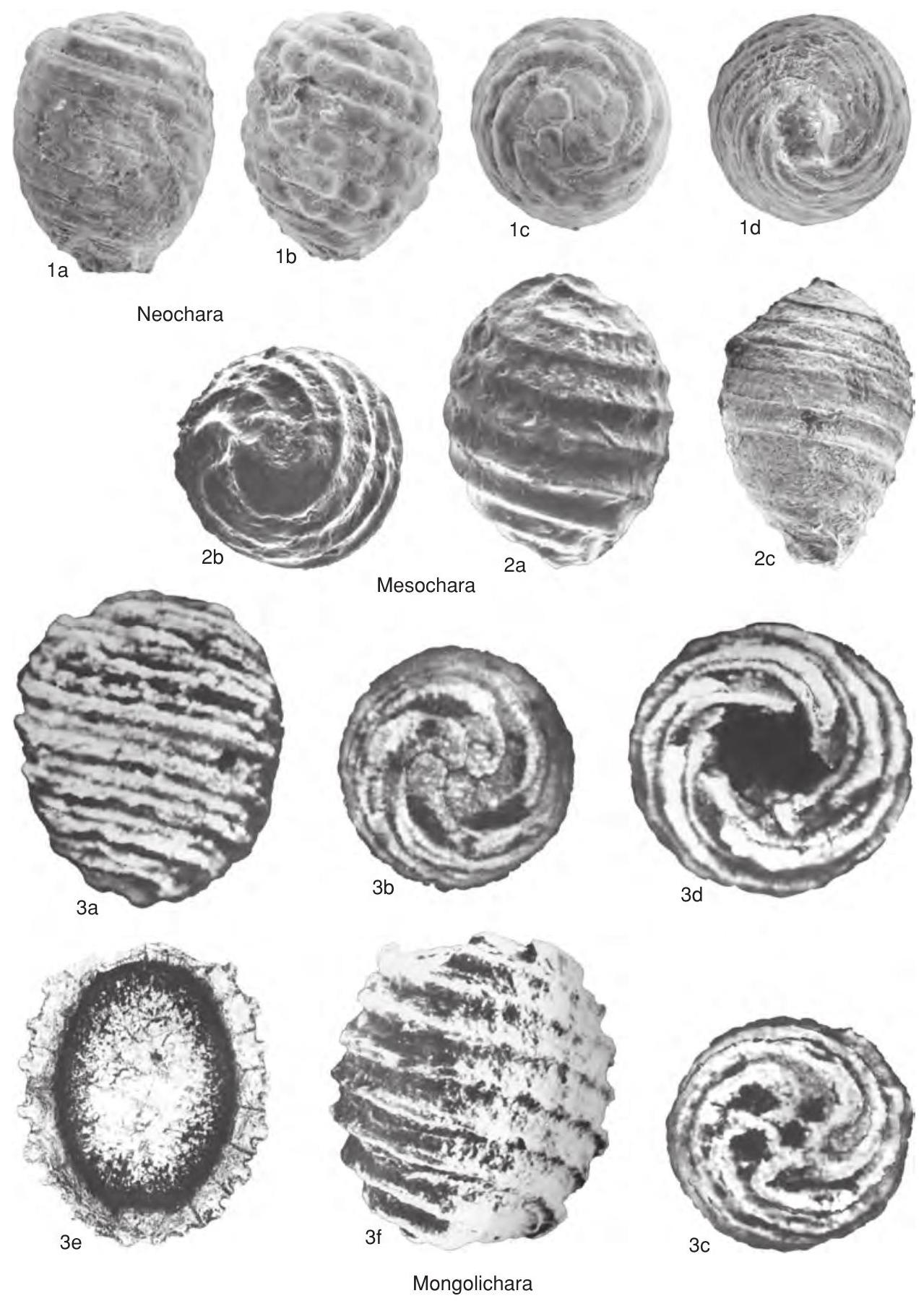 Fig. 71,3a-f. * M. gobica (Karczewska & Ziembińska-Tworzydeo) Karczewska & Kyansep-Romaschiina, Upper Cretaceous, Mongolia, a, holotype, lateral view, b, apical view, c, basal view, d, apical view, open summit, x80 (Karczewska & Ziembińska-Tworzydło, 1970, pl. XXXIII, 1 c, 1 a, 1 b, 2 ), e, longitudinal section, x70 (Karczewska & Ziembińska-Tworzydło, 1981, pl. 35,0), f, lateral view, x80 (Karczewska & KyansepRomaschkina, 1979, pl. 3,4).
Synonyms
Geographic Distribution
China, Mongolia
Age Range
Beginning Stage in Treatise Usage:
Upper Cretaceous
Beginning International Stage:
Cenomanian
Fraction Up In Beginning Stage:
0
Beginning Date:
100.5
Ending Stage in Treatise Usage:
Paleogene (lower Eocene)
Ending International Stage:
Ypresian
Fraction Up In Ending Stage:
100
Ending Date:
48.07
Description
Apex lamprothamnoid, with spirals narrowing and thining on apex periphery, then slightly widening and thickening somewhat in apex center, without forming distinct nodules, General shape prolate spheroidal to subprolate, with apex center forming rounded or truncated cap, base rounded, in some species base slightly tapered, Spirals occasionally with surface ornamentation, especially secondary ridges or small cellular tubercles, Basal plate variable in thickness, generally thinner than wide, Size medium. [ Differs from Peckichara in absence of apical nodules and weaker ornamentation.]
References
Museum or Author Information
Classification
Phylum:
Charophyta
Class:
Charophyceae
Order:
Charales
Suborder:
Charineae
Family:
Characeae
Subfamily:
Charoideae
Formal Genus Name and Reference:
Mongolichara Kyansep-Romaschkina, 1975, p. 200, emend., Karczewska & KYANSEP-ROMASCHKINA, 1979, p. 423
Type Species:
Tectochara gobica Karczewska & ZIEMBIŃSKA-TWORZYDŁO, 1970, p. 137, pl. 33, 1-2, OD
Images
(Click to enlarge in a new window)
Fig. 71,3a-f. * M. gobica (Karczewska & Ziembińska-Tworzydeo) Karczewska & Kyansep-Romaschiina, Upper Cretaceous, Mongolia, a, holotype, lateral view, b, apical view, c, basal view, d, apical view, open summit, x80 (Karczewska & Ziembińska-Tworzydło, 1970, pl. XXXIII, 1 c, 1 a, 1 b, 2 ), e, longitudinal section, x70 (Karczewska & Ziembińska-Tworzydło, 1981, pl. 35,0), f, lateral view, x80 (Karczewska & KyansepRomaschkina, 1979, pl. 3,4).
Synonyms
Geographic Distribution
China, Mongolia
Age Range
Beginning Stage in Treatise Usage:
Upper Cretaceous
Beginning International Stage:
Cenomanian
Fraction Up In Beginning Stage:
0
Beginning Date:
100.5
Ending Stage in Treatise Usage:
Paleogene (lower Eocene)
Ending International Stage:
Ypresian
Fraction Up In Ending Stage:
100
Ending Date:
48.07
Description
Apex lamprothamnoid, with spirals narrowing and thining on apex periphery, then slightly widening and thickening somewhat in apex center, without forming distinct nodules, General shape prolate spheroidal to subprolate, with apex center forming rounded or truncated cap, base rounded, in some species base slightly tapered, Spirals occasionally with surface ornamentation, especially secondary ridges or small cellular tubercles, Basal plate variable in thickness, generally thinner than wide, Size medium. [ Differs from Peckichara in absence of apical nodules and weaker ornamentation.]